Case Study
The New Standard for Confidential Token Distribution
May 14, 2026
KAIO Launches $KAIO via Zama & TokenOps. KAIO is the first institutional protocol to deploy FHE-powered token distribution with its $KAIO launch. Here’s what that means and why it matters.
KAIO, the institutional RWA protocol backed by Nomura’s Laser Digital, has launched its $KAIO token using the first ecosystem deployment of FHE-powered token distribution. Following the blueprint set by the $ZAMA token launch in January 2026, KAIO is now bringing this privacy-first infrastructure to the world of institutional finance.
This launch is powered by TokenOps, a battle-tested no-code token operations platform used by 30+ projects, built on the Zama Protocol. By leveraging this stack, KAIO ensures that allocation amounts, and airdrop quantities remain encrypted on-chain. For a protocol managing tokenized funds to Basel and MiFID standards, public transparency was never an option. This launch proves that on-chain operations can finally meet the strict confidentiality requirements of global finance.
“We needed distribution infrastructure for our community airdrop that matched the institutional credibility that KAIO had built as the foundation of our brand. A public, gameable token distribution was never an option for $KAIO. TokenOps and Zama gave us the only solution where allocations stay encrypted on-chain while remaining fully auditable, which is the standard our users and partners deserve.”
- Shrey Rastogi, CEO, KAIO
The Problem: When Transparency Becomes a Liability
Traditional launches broadcast investor data to the entire world, leading to three critical failures:
Market Manipulation: "Whale-tracking" tools allow traders to front-run unlock events. Data shows token prices often drop 7–15% around major unlocks as the market anticipates sell pressure.
Targeted Exploits: In 2025, over $3.4 billion was stolen across the ecosystem. Publicly visible vesting schedules turn high-net-worth holders into targets for sophisticated phishing and wallet compromises.
Regulatory Conflict: Institutions and family offices often have strict confidentiality obligations. Publishing their specific LP allocations on a public block explorer is fundamentally at odds with how regulated funds operate.
Until now, the only alternative was using Centralized Exchanges (CEXs). However, CEX launches require giving up custody and sacrificing the on-chain verifiability that makes blockchain valuable.
TokenOps and Zama offer a different path: on-chain, self-custodial, fully verifiable, and encrypted. Sensitive data stays private while the blockchain still enforces every rule.
The Solution: Confidentiality by Design
What is an FHE token distribution?
The Zama Protocol introduces a new path: Fully Homomorphic Encryption (FHE). This allows smart contracts to perform calculations on encrypted data without ever "seeing" the underlying numbers. The smart contract computes on encrypted data without ever decrypting it: tokens release on schedule, eligibility is enforced, and balances update correctly, but the underlying amounts and recipient details stay private. Only the recipient’s wallet can decrypt its own allocation.
How FHE works
Fully Homomorphic Encryption lets you run computations on encrypted data without ever decrypting it. Picture a locked box where someone inside can rearrange the contents, add items, remove items, follow complex instructions - all without opening the lid. The box stays sealed the whole time.
The Zama Protocol is a framework that brings this to EVM-compatible blockchains. Their confidential smart contracts use encrypted variables instead of plain-text ones. So when TokenOps deploys an airdrop contract for KAIO, the token amounts and, recipient details are encrypted at the contract level.
This is fundamentally different from zero-knowledge proofs, which prove a statement without revealing it. FHE computes on the encrypted data itself without the need of ‘trusted’ third-parties, off-chain computation or privacy coins like Zcash. Just encrypted, verifiable, on-chain token operations.
And it’s standard Solidity running on fhEVM, audited by OpenZeppelin, compatible with existing toolchains like Hardhat and Foundry. The encryption is baked into the execution layer itself.
What KAIO deployed for $KAIO
The $KAIO launch utilizes a dual-stack approach to ensure maximum flexibility and security:
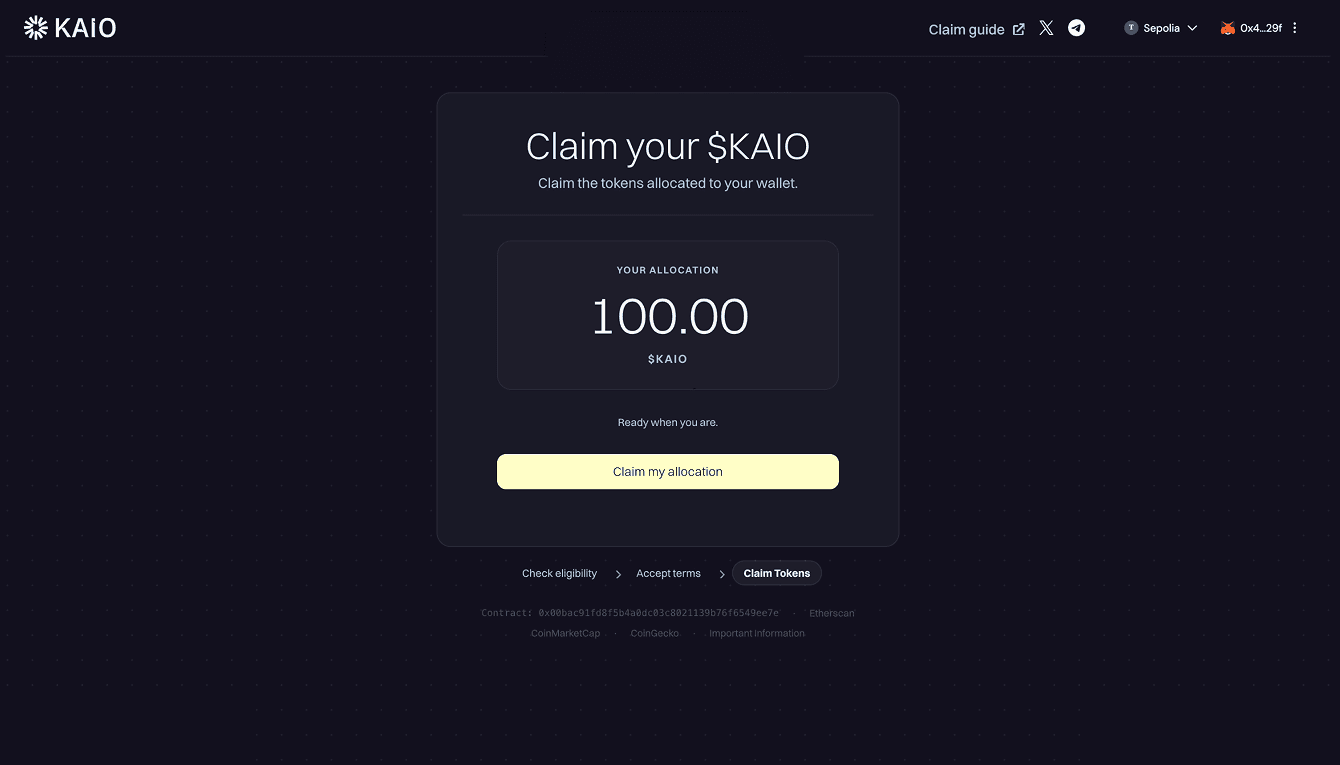
A branded claim page for $KAIO recipients, with FHE-powered confidential airdrop smart contract, audited by OpenZeppelin. The experience feels like any standard claim flow – but underneath, every allocation is encrypted on-chain using FHE. In a single UI, airdrop receivers have the opportunity to claim their individual allocation encrypted on-chain using Zama’s fhEVM, via the ERC-7984; or alternatively, using the classic ERC-20.
This a pioneering approach that ensure that each user has full discretion:
i) ERC-7984 for privacy. No public observer, competitor, or analytics platform can see who received what, only the recipient’s wallet can decrypt its own allocation. This eliminates the “who got how much” drama that can erode community trust after public airdrops.
ii) ERC-20 for transparency. Old-school and visible on-chain.
Fig. 1 - $KAIO claim portal
“For two years, privacy was the number one request from our customers. Building on the Zama Protocol changed everything. The KAIO launch is the first proof point of a deep pipeline of institutional projects moving toward a private-by-default standard. ”
– Fabio Mancini, Co-Founder & CEO, TokenOps
“Zama Protocol enables smart contracts to compute encrypted data without ever exposing it. We proved the model with our own token launch, and TokenOps is scaling this to provide a complete privacy stack for the entire token lifecycle, from capital formation to distribution.”
– Rand Hindi, Co-Founder & CEO, Zama
How TokenOps compares to other vesting platforms
Sablier, Superfluid, LlamaPay are all respected protocols for streaming and vesting. TokenOps has worked alongside these protocols for years, integrating with them where it made sense. But none of them offer encrypted balances. None of them can keep allocation sizes out of public view. They were built for a world where transparency was the only option.
TokenOps has processed over $2 billion in distributions across 500,000+ transactions, with top tier projects like Redstone, Redbelly, Taiko, One Football, Bob Network distributing tokens on our battle tested smart contracts.
By building directly on the Zama Protocol, TokenOps now offers something no other vesting or distribution platform can: confidential token operations that are still fully verifiable onchain. The combination of battle-tested distribution infrastructure and FHE encryption is a category of one.
FHE vs. centralized and custodial distributions
Other players like Hedgey, Liquifi, Magna have been absorbed by centralized exchanges and custodians. It is worth highlighting that CEX distributions outsource trust to a centralized intermediary, with transparency given as an incident of centralization. FHE distributions flip the model on its head and eliminate the need for that trust entirely.
Fig. 2 - Comparison table of CEX/Custodial vesting vs. TokenOps with FHE vesting
Centralized/Custodial Distribution | TokenOps + Zama FHE | |
Custody | Custodial: custodian/exchange holds tokens until release | Self-custodial: recipients claim directly to their wallet |
Visibility | Opaque: allocations controlled internally | Encrypted on-chain: only recipients decrypt their own data |
Manipulation risk | Exchange insiders, data leaks, centralized failure points | No public data to exploit; Sybil/bot attacks neutralized |
Compliance | KYC via exchange: data held by third party | Selective decryption for auditors/regulators; data stays on-chain |
Verifiability | Trust-based: participants trust the exchange | Cryptographically verifiable: blockchain validates every transition |
Ethos | Centralized, permissioned, KYC-gated | Decentralized, self-sovereign, crypto-native |
What’s next
Permissionless app launches soon. Any team will be able to deploy confidential distributions directly through the TokenOps app; no sales process, no demo required. Connect a wallet, configure your parameters, deploy. This opens FHE-powered distribution to the long tail of crypto projects that need privacy but don’t have enterprise budgets.
Multi-chain expansion targeting Q3/Q4 2026. Base and Solana are on Zama’s roadmap, extending TokenOps beyond its current EVM footprint. As Zama’s privacy layer expands to new networks, TokenOps follows.
Full-lifecycle FHE products. Confidential staking, governance, and presales are all being built on the same FHEVM foundation. Zama built the first on-chain sealed-bid Dutch auction for its own $ZAMA token sale in January 2026, where bid quantities were encrypted to prevent cartel bidding and front-running. TokenOps is bringing that same level of confidentiality to every stage of the token lifecycle; from capital formation through distribution and ongoing operations.
Teams approaching TGE right now are making distribution decisions that are hard to undo. The infrastructure you choose determines whether your allocations are public or private, whether your community is protected or exposed, and whether your competitors know your strategy before you execute it.
About TokenOps
TokenOps.xyz is the enterprise-grade platform for confidential token operations. By leveraging the Zama Protocol, TokenOps enables projects to automate distributions, vesting, and airdrops with full onchain encryption. We bridge the gap between blockchain transparency and institutional privacy, ensuring sensitive allocation data remains protected yet cryptographically verifiable.
Our solutions include:
Confidential Token Vesting and Distribution: Automate complex vesting schedules with encrypted allocations, onchain security, and perfect alignment with legal agreements
Sealed-Bid Dutch Auctions: Run FHE-powered capital raises where bid quantities stay encrypted, preventing front-running, cartel bidding, and gas wars. Zama validated this model during its own $ZAMA token sale in January 2026
Global Tax Withholding: Navigate international tax compliance seamlessly during token distribution operations, ensuring regulatory adherence across jurisdictions
Confidential Airdrops: Deploy encrypted airdrop campaigns with strategic lockups to maximize community engagement while protecting recipient privacy
FAQs
What is an FHE token distribution?
An FHE token distribution is a token launch where allocation data is encrypted on-chain using Fully Homomorphic Encryption. Smart contracts compute on the encrypted data, releasing tokens and enforcing eligibility without ever decrypting it. Only the recipient's wallet can see its own allocation. The Zama Protocol is the infrastructure layer that makes this possible on Ethereum and EVM-compatible chains.
How is KAIO using TokenOps for the $KAIO launch?
KAIO is distributing $KAIO through an FHE-powered airdrop contract deployed via TokenOps. Recipients claim through a branded portal where every allocation is encrypted on-chain, with the option to claim as confidential ERC-7984 or standard ERC-20. This is the first live FHE token distribution ever deployed.
Why can't zero-knowledge proofs do what FHE does for token distributions?
ZK proofs verify a statement without revealing the underlying data, but they cannot compute on it. Vesting contracts need to calculate release amounts, check cliff dates, and update balances, all operations that require computation on encrypted inputs. FHE handles this natively, which is why TokenOps uses the Zama Protocol for confidential token distributions instead of ZK-based approaches.
What chains and token standards does TokenOps support?
TokenOps supports 10+ EVM-compatible chains and works with both standard ERC-20 tokens and Zama's confidential ERC-7984 standard. FHE multi-chain expansion to Polygon and others is on the roadmap for late 2026.
Can TokenOps handle large-scale token launches?
Yes. TokenOps has processed over $2 billion in distributions across 500,000+ transactions for projects like Redstone. Enterprise teams can book a demo for hands-on deployment, while self-serve users can connect a wallet and configure distributions directly through the app.


